Monocouche vs traditional render: what's the difference?
Monocouche and traditional render can both provide a durable external finish, but they achieve the finished appearance in different ways.
The right choice depends on the building, the background, the appearance you want and how the complete render system is specified.
The main differences
| Monocouche render | Traditional rendered finish | |
|---|---|---|
| Colour | Pigment runs through the render | Commonly finished with paint |
| Typical appearance | Consistent scraped or roughcast finish | Can accommodate a range of finished textures |
| Build-up | Proprietary render system | Depends on the specified render build-up |
| Initial painting | Usually not required for through-coloured finish | Commonly painted after appropriate curing |
| Future appearance | Colour is integral to the finish | Colour can be changed relatively easily by repainting |
| Local repairs | Texture and weathered colour can be difficult to match invisibly | Repairs can sometimes be visually unified by repainting |
| Suitability | Depends on substrate and chosen system | Depends on substrate and chosen system |
“Traditional render” can refer to different specifications, so the exact materials and layer build-up should always be confirmed rather than treated as one universal product.
What is monocouche render?
Monocouche is a pre-mixed mineral render containing colour throughout the material.
It is commonly applied to masonry and finished with a scraped texture, although other finishes are available depending on the system.
Because the colour is incorporated into the render, a separate coat of masonry paint is not normally needed to create the initial finished appearance.
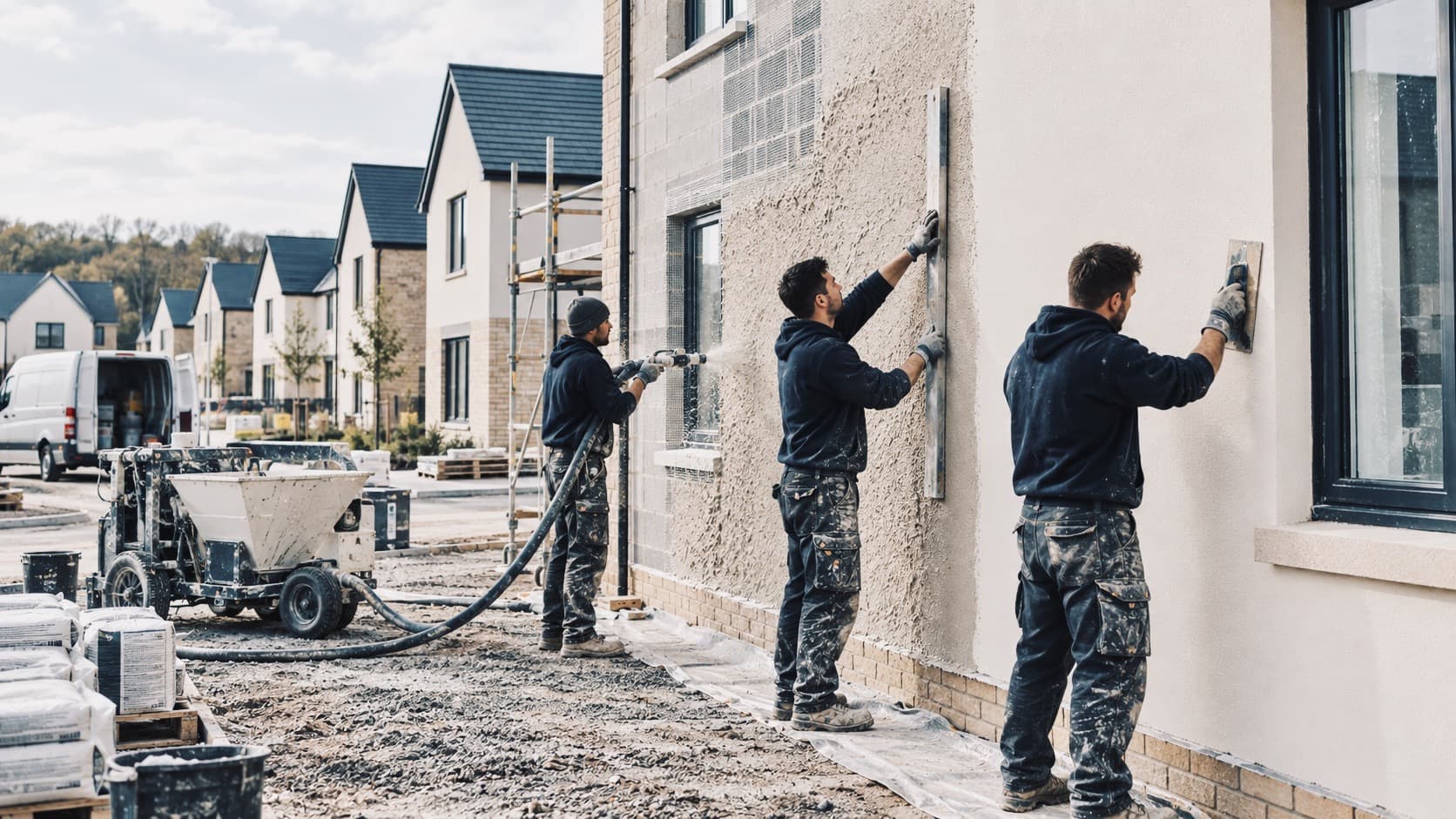
Modern monocouche products can also be applied by render pump, which can be useful on larger areas.
What do people mean by traditional render?
For this comparison, traditional render means a conventional rendered finish that is subsequently decorated rather than relying on a through-coloured top layer.
There are several possible render specifications, so it is important not to assume that every “traditional” rendered wall has the same construction.
The background, exposure and existing building fabric should inform the system used.
Which looks better?
That is mostly a design choice.
Monocouche is often chosen where a crisp, uniform scraped finish is wanted without subsequent painting.
A painted render system offers greater freedom to change colour later and may suit properties where that appearance is already part of the building.
The surrounding elevations, extensions and neighbouring materials should also be considered. A technically good render can still look wrong if the finish is unsympathetic to the property.
Which is lower maintenance?
Through-coloured monocouche avoids the need for an initial decorative paint finish, which removes one maintenance item.
That does not mean it is maintenance-free. Exterior surfaces still weather and can accumulate dirt or organic growth.
Traditional painted render will eventually need recoating when the decorative finish reaches the end of its serviceable condition.
The actual maintenance requirement depends on exposure, detailing, surface condition and the product system used.
What happens when repairs are needed?
Repairs to any render need to deal with the reason for the defect first.
One practical consideration with monocouche is appearance: matching an aged through-coloured render locally can be difficult because the original surface has weathered. Weber similarly notes that noticeable crack repairs can be difficult to colour-match, particularly on older or strongly pigmented finishes.
With painted render, a repaired area may be easier to visually unify when an elevation is subsequently redecorated.
That should not be the sole reason for choosing a system, but it is worth considering.
Which is better for an older property?
Age alone does not provide the answer.
Older buildings can have different masonry, moisture behaviour and previous coatings from modern construction. The render system therefore needs to be compatible with the actual building rather than selected solely because one product looks newer or more traditional.
The existing wall should be assessed before specifying the finish.
So which should you choose?
Start with the property rather than the product.
Consider:
the existing background, condition of any current render, desired appearance, exposure, detailing, maintenance expectations and whether the work forms part of a new build, extension or refurbishment.
That gives a much better basis for choosing a render system than comparing appearance alone.
Considering new render?
Send photographs of the elevations and tell us what finish you have in mind. We can advise on the options that suit the existing building.